High-Efficiency Hydrocyclone Separator – Advanced Classification Solution
Mar 23,2026
A hydrocyclone is a high-performance separation and classification device designed to process liquid-solid mixtures using centrifugal force.

A hydrocyclone is a high-performance separation and classification device designed to process liquid-solid mixtures using centrifugal force. When slurry is fed tangentially into the unit under pressure, a strong rotational vortex is generated inside the cylindrical and conical structure. This centrifugal motion forces heavier or coarser particles outward toward the wall and downward to the underflow outlet, while finer particles and liquid move upward through the central vortex and exit via the overflow pipe. This continuous and efficient separation process allows hydrocyclones to achieve precise particle classification without any moving parts, ensuring stable operation and low maintenance requirements.
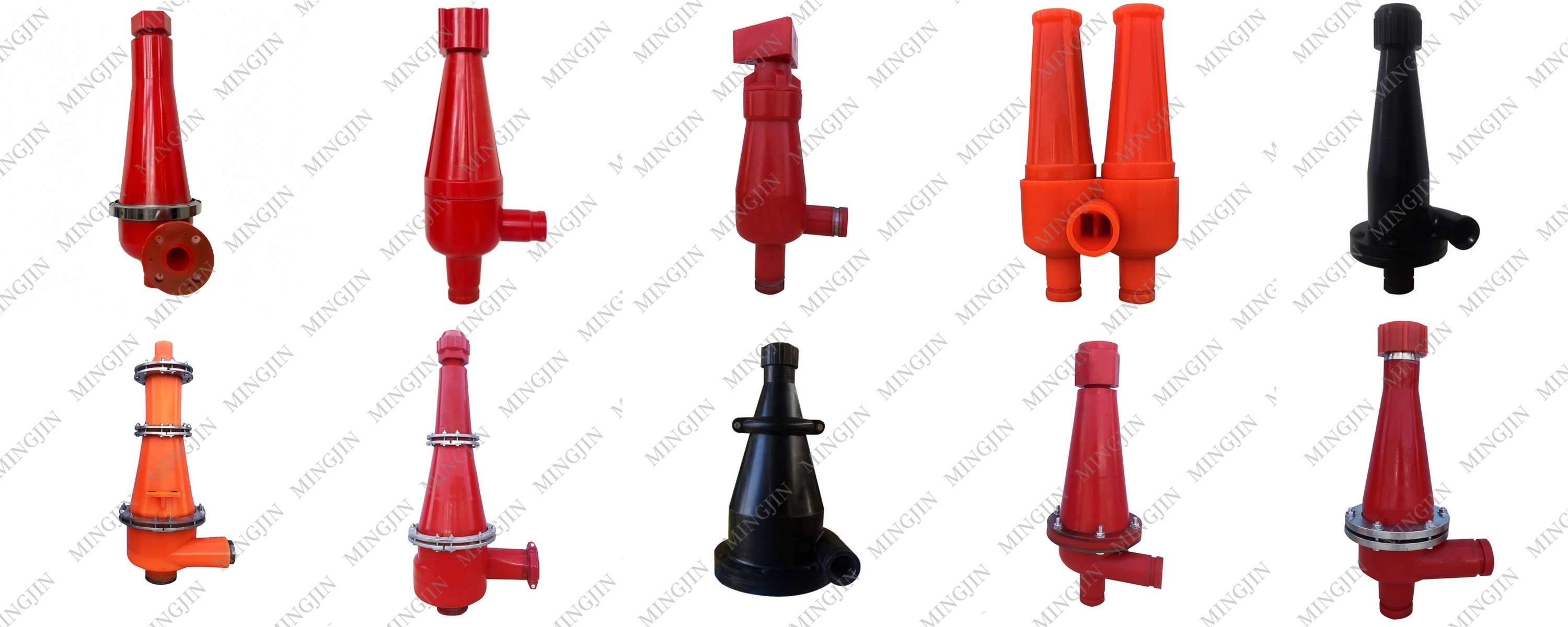
Modern hydrocyclones are engineered with advanced materials such as polyurethane, rubber linings, or ceramic composites to enhance wear resistance and extend service life in abrasive environments. Their compact design, high processing capacity, and customizable structure—including inlet diameter, cone angle, and vortex finder—enable flexible adaptation to different working conditions. With high classification efficiency and the ability to handle varying feed concentrations, hydrocyclones are widely recognized as cost-effective solutions for continuous industrial separation processes.

Product Features
Hydrocyclones offer a wide range of technical advantages that make them indispensable in modern processing systems. First, they provide high-efficiency separation, capable of classifying particles based on size, density, and shape with excellent precision. Second, the absence of mechanical moving parts significantly reduces maintenance costs and operational complexity while improving reliability. Additionally, their compact footprint allows easy installation even in limited spaces, making them ideal for both large-scale plants and modular systems.
Another key feature is their high throughput capacity, enabling continuous operation with large flow rates while maintaining stable performance. The internal structure can be optimized through customized designs, such as multi-cone configurations or adjustable apex sizes, to achieve specific separation requirements. Furthermore, the use of wear-resistant materials ensures long service life, even in highly abrasive or corrosive environments. These characteristics collectively contribute to improved productivity, reduced downtime, and enhanced overall process efficiency.
Application Scenarios
Hydrocyclones are widely used across multiple industries due to their versatility and efficiency. In the mining and mineral processing industry, they are essential for grinding classification, desliming, concentration, and tailings management, helping improve recovery rates and optimize downstream operations. They are also extensively applied in coal washing plants, where dense medium cyclones are used to separate coal from impurities based on density differences.
In industrial sectors such as chemical processing, oil and gas, and wastewater treatment, hydrocyclones are used for solid-liquid separation, sand removal, and purification processes. They effectively remove suspended solids and improve fluid quality, making them suitable for environmental protection systems and industrial water recycling. Additionally, in the food and starch industries, hydrocyclones play a key role in concentrating and refining starch suspensions, ensuring product consistency and quality.
Conclusion
As a reliable and efficient separation device, the hydrocyclone combines simple structure, high performance, and low operational cost. Its ability to deliver precise classification, handle large processing volumes, and operate continuously makes it an essential component in modern industrial systems. With customizable configurations and durable construction, hydrocyclones provide a flexible and long-lasting solution for a wide range of applications, from mining and chemical processing to environmental and food industries.
Key words: